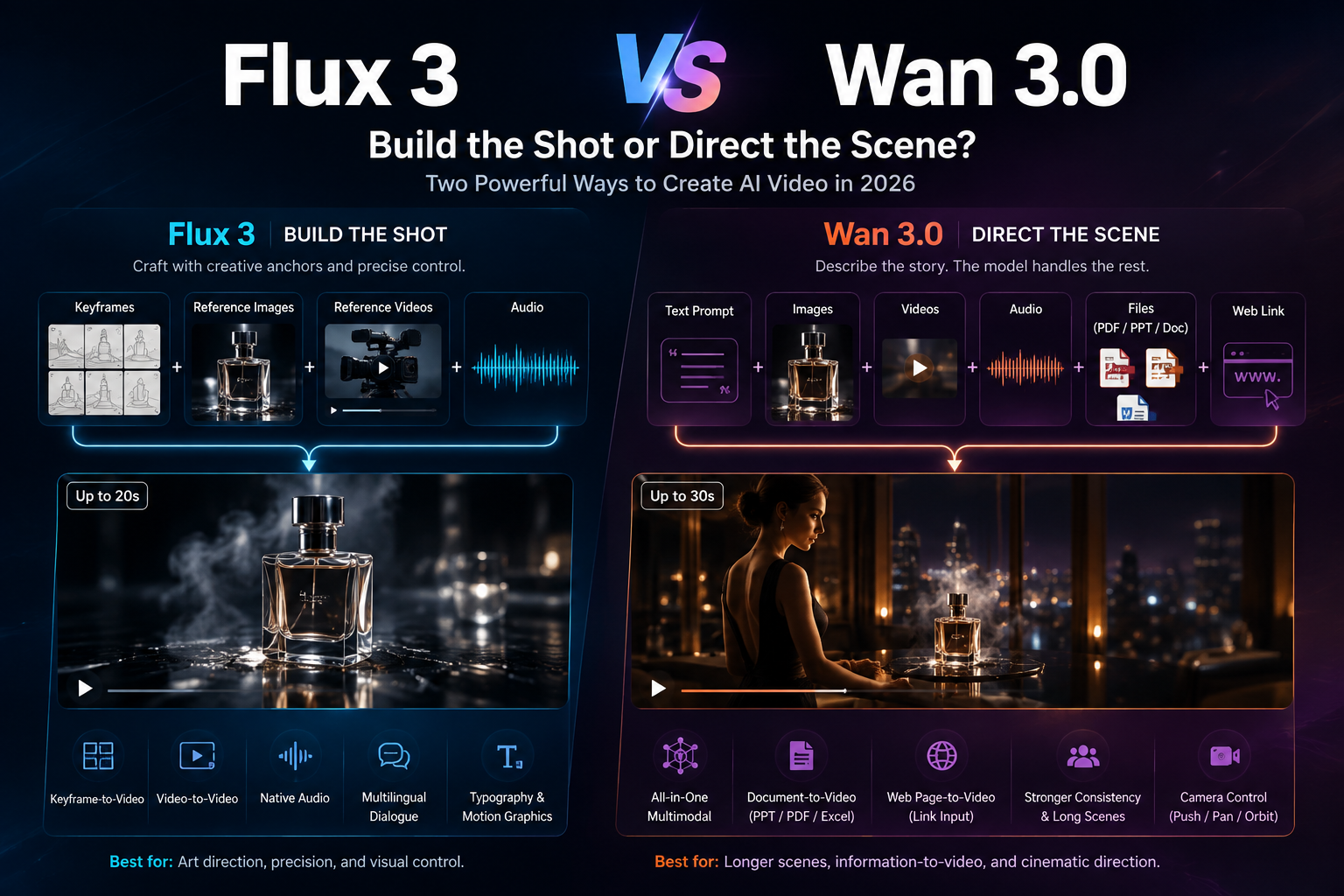
Start with how you think about a shot.
You already know the opening frame, closing frame, character reference or source footage and want the model to build motion between controlled visual anchors.
You want to describe a longer scene, direct the camera and let character and action unfold naturally in one continuous generation.
Both entered usable rollout in summer 2026, but access channels and feature maturity still vary. Confirm the exact product endpoint before planning production.
The core difference: build the shot vs direct the scene
The distinction is more useful than memorizing which specification number is larger. FLUX 3 starts from creative anchors; Wan 3.0 starts from a directed sequence.
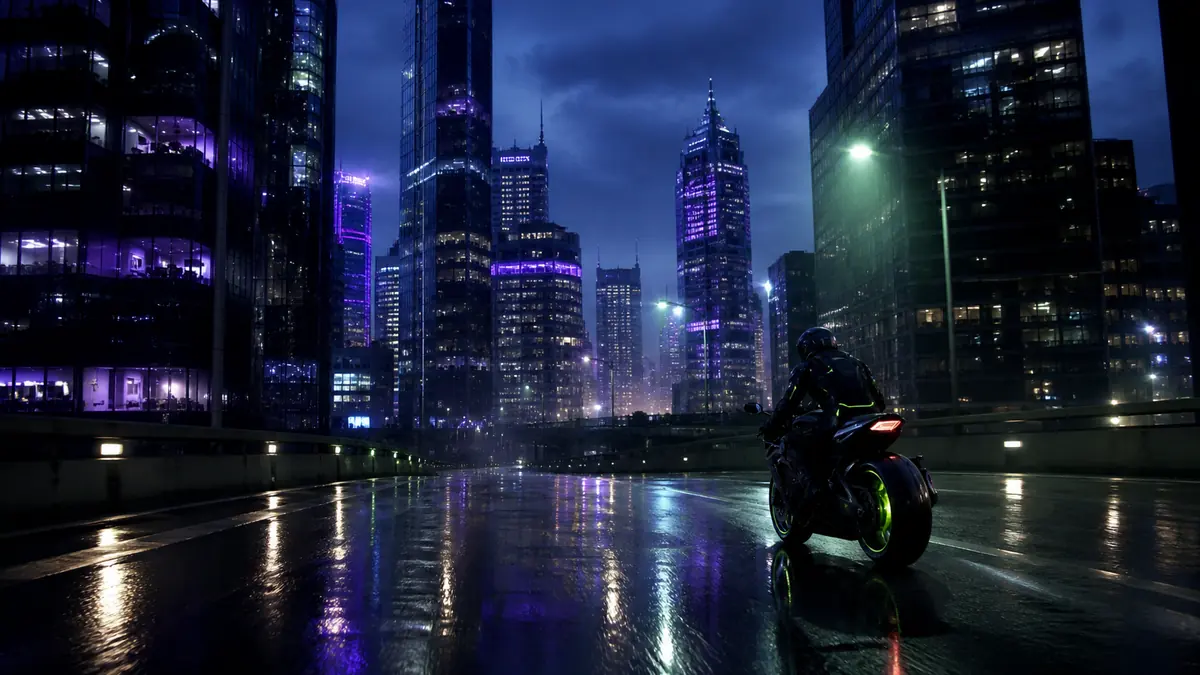
FLUX 3 builds the shot
Starting frame to ending frame to generated motion—or reference video plus character reference to a new scene. FLUX 3 combines text-to-video, image-to-video, video-to-video, keyframe-to-video and multilingual dialogue, so creation can begin with two frames or existing footage rather than one long prompt.
Best for: hero shots, transformations, typography, native dialogue and reference-led motion.
Wan 3.0 directs the scene
Character, environment, action and camera direction become a longer scene generated as one continuous take. Its official API also lists text, image, video, audio, files and web links as inputs, moving it closer to an all-in-one interface for turning existing information into video.
Best for: continuous 30-second scenes, camera-led narratives, document-to-video and link-to-video workflows.
Seven scenarios that expose the workflow difference
A camera commercial hero shot
A rounded-rectangle camera body, 2.1:1 ratio, with a large lens occupying 68% of its height and a matte silver aluminum frame. Warm key light sweeps from upper-left across the body. The camera orbits slowly, then the aperture blades close, holding centered on the camera. No logos or text.
If you already have a product reference, an opening composition and a target hero frame, FLUX 3's keyframe-driven approach is the more direct route: set the first and last frame and let the model fill in the orbit. Wan 3.0 is directed through camera instructions such as slow orbit, slight push-in and hold on product. Its longer runtime also helps when an ad needs several visual phases.
A fishing rod brand story
An angler casts his line into a lake. The camera follows the line through a sunken city's neon ruins. A fish bites, revealing the brand name carved into its side.
FLUX 3's 20-second ceiling favors a conventional shot-by-shot workflow: generate several clips, use references to preserve continuity, then assemble them in editing. Wan 3.0 supports up to 30 seconds in one continuous take, so a complete brand story can be attempted in a single generation with fewer transition resets.
A two-person dialogue scene
A man and a woman sit in a quiet restaurant. She asks whether the campaign is ready. He answers while looking at his tablet. They pause and smile as the camera slowly pushes toward the table.
This scene tests expression, voice, dialogue timing and camera movement together. FLUX 3 officially generates native audio with the video. Wan 3.0 documents audio inputs, but its public materials are less specific about the complete audio pipeline. When dialogue and lip sync are decisive, test FLUX 3 first and score exact wording, timing and speaker separation.
Animate an existing character
The mecha keeps the design from the first image, in camouflage green and fire orange, referencing the second image. It dives onto a desert battlefield, cracks the ground on landing, fires and blasts off through the gunfire.

FLUX 3 supports image and video references, and video-to-video can carry core elements into a new scene. Wan 3.0 documents up to 10 reference images, 5 reference videos and 5 reference audio files in one generation. That can combine character, product, camera-motion and voice references, but these are provider claims and documentation statements; test the same character on both systems.
On-screen typography
A crystal-cut perfume bottle sits on polished black marble. Warm light sweeps across the glass while the camera orbits. Fine mist drifts in the background. The tagline ROASTED DAILY animates onto the frame with crisp, undistorted letterforms.
Typography is a category where video models commonly struggle. FLUX 3's Self-Flow architecture jointly trains image, video and typography, and Black Forest Labs lists typography as a capability. Wan 3.0 materials emphasize duration, camera control and consistency instead. Test FLUX 3 first, then inspect every visible character frame by frame.
Turning an existing document into video
A 10-page product specification deck that needs to become a narrated walkthrough automatically.
This is currently a Wan 3.0-specific advantage. It accepts DOC, XLS, PPT, PDF and Markdown files directly, up to the provider's documented limits. Alibaba's API documentation includes an example in which a PPTX product deck is interpreted into a product advertisement. FLUX 3 accepts text, image, video and audio, but does not document direct document input.
Turning a web page directly into video
An existing product landing page needs to become a promotional video without collecting its copy and assets again.
Wan 3.0 lists Link as an input type, allowing a URL to be interpreted into video. This can shorten e-commerce, SaaS and education workflows built around existing landing or product pages. FLUX 3 does not currently list web links as a supported direct input.
What do you actually want to control?
FLUX 3—keyframe-to-video directly addresses this task.
Wan 3.0—camera direction is central to its scene workflow.
FLUX 3—video-to-video and continuation support reworking a source clip.
Test Wan 3.0—consistency is a stated focus, but verify it yourself.
Test FLUX 3 first—native audio is explicitly documented.
Test FLUX 3 first—typography is an officially listed capability.
Wan 3.0 is the documented option.
Wan 3.0 is the documented option.
FLUX 3 vs Wan 3.0 at a glance
| Decision factor | FLUX 3 | Wan 3.0 |
|---|---|---|
| Maximum documented clip | Up to 20 seconds | Up to 30 seconds |
| Creative model | Build motion between references and keyframes | Direct a longer continuous scene |
| Native audio | Explicitly documented multilingual dialogue, effects and ambience | Audio input documented; verify output behavior on the selected endpoint |
| Reference inputs | Images, video and ordered frames | Up to 10 images, 5 videos and 5 audio files per documented generation |
| Documents and links | Not listed as direct inputs | Documents and web links listed as direct inputs |
| Best starting point | Controlled hero shots and transformations | Long scenes and information-to-video automation |
Both models can generate video today.
FLUX 3 video entered early access on July 23, 2026. On this FLUX 3 Studio interface, text-to-video is live at 720p and 1080p while other product capabilities continue to roll out.
Wan 3.0 opened to public beta on August 6, 2026. Alibaba Cloud Model Studio identifies the model as wan3.0-video, with access also appearing through Wanxiang and Qwen creation tools. Availability remains staged across entry points.
Check duration, resolution, reference limits, audio behavior, moderation and pricing at the exact entry point you plan to use.
FLUX 3 vs Wan 3.0 questions
Which supports longer video?
Wan 3.0 supports up to 30 seconds in a single continuous shot. FLUX 3's documented video ceiling is 20 seconds.
Does FLUX 3 support audio?
Yes. Its documented capability includes native audio and multilingual dialogue generated alongside video.
Does Wan 3.0 support document-to-video?
Yes. It accepts DOC, XLS, PPT, PDF and Markdown files directly, and Alibaba documents a PPT-to-product-ad example.
Can Wan 3.0 generate from a web link?
Yes. Its official API lists Link as an input type. FLUX 3 does not currently document direct URL input.
How many reference files can Wan 3.0 accept?
The official API documentation lists up to 10 reference images, 5 reference videos and 5 reference audio files in one generation.
Is FLUX 3 fully released?
Not entirely. Video and action prediction remain in early access while other capabilities and open-weight releases continue rolling out.
Which is better for advertising and e-commerce?
Test FLUX 3 first for precise short composition, native audio and typography. Test Wan 3.0 first for a longer narrative or direct conversion of product documents and pages.
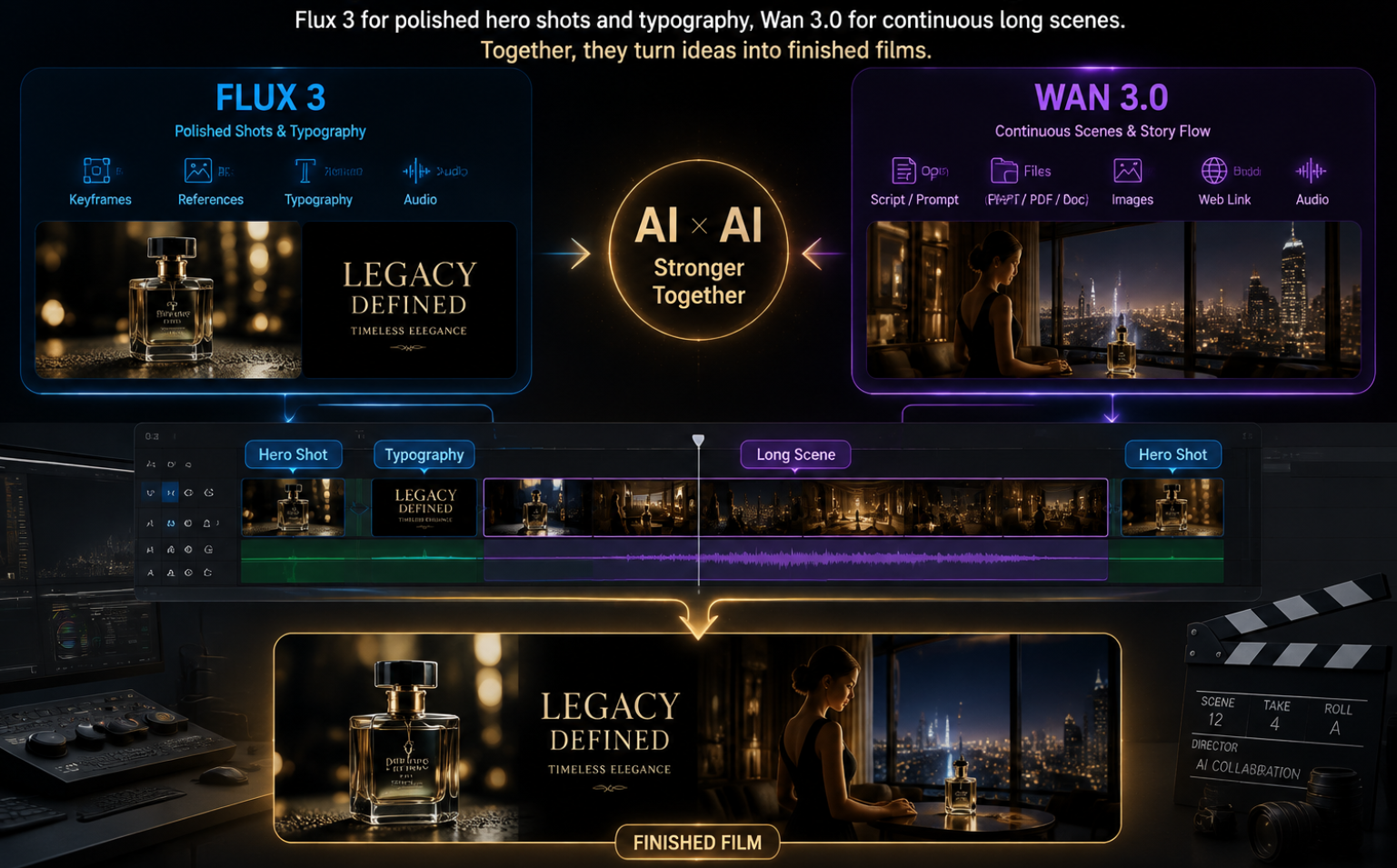
Maybe the better answer is using both.
Many production teams may use FLUX 3 for polished hero shots, dialogue scenes and typography-heavy frames; Wan 3.0 for continuous long takes that need to unfold in one shot; and conventional editing software to combine the strongest results.
This mixed workflow is more realistic than forcing every shot type through one model. Test identical briefs, retain failed generations and choose by the percentage of usable outputs.
Test FLUX 3 Studio →Verify the current endpoints
www-flux3.net is an independently owned and operated platform. It has no affiliation with, sponsorship from, or endorsement by Black Forest Labs, FLUX 3, Alibaba Wan, AI Video Extender, or any other provider referenced on this site. Product limits and public access can change.
Black Forest Labs — FLUX 3 announcement ↗Alibaba Cloud — Wan 3.0 video API reference ↗Measure the complete route from brief to approved clip
A price-per-generation comparison is incomplete when the workflows solve different problems. Build a small benchmark from actual project requirements: a controlled product hero, a dialogue shot, a character continuation, a continuous camera move and an information-to-video task. Give FLUX 3 and Wan 3.0 equivalent references and the same acceptance criteria, then retain both successful and failed attempts.
Record generation cost, queue time, prompt revisions, source preparation, rejected outputs, audio replacement, continuity repair and final editing. Divide that total by approved clips. FLUX 3 may reduce repair when opening and ending frames or native dialogue are decisive; Wan 3.0 may reduce assembly work when a long scene or direct document input succeeds in one pass. These are hypotheses to test, not guaranteed winners.
Run the benchmark on the exact product or API endpoint planned for production. Duration, resolution, input limits, audio behavior, moderation and pricing can differ across access channels. Save the model name, date, settings and source files so a later update can be measured against the same evidence.